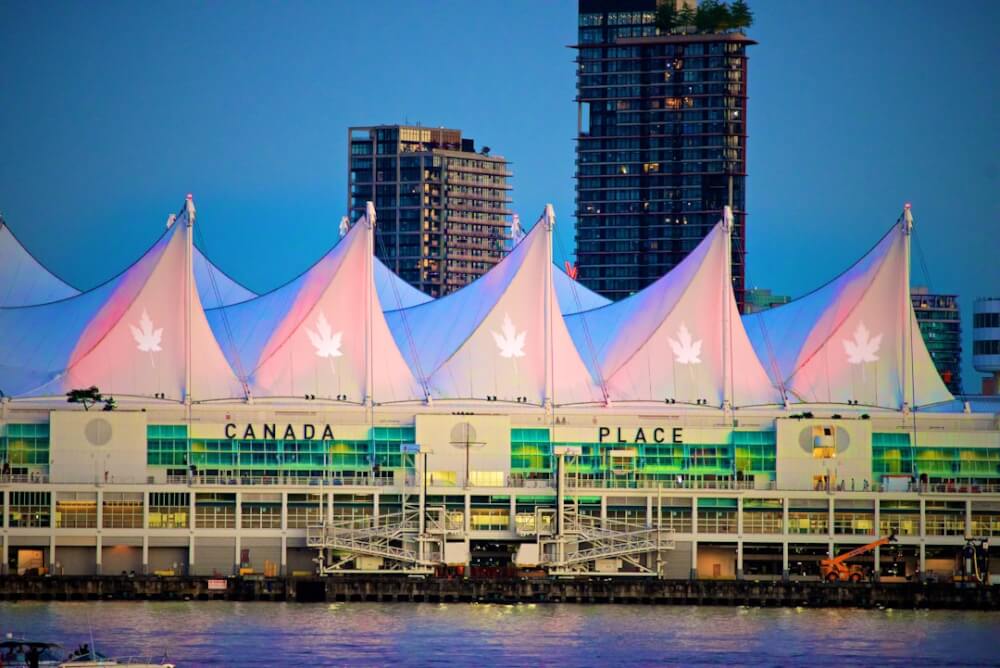

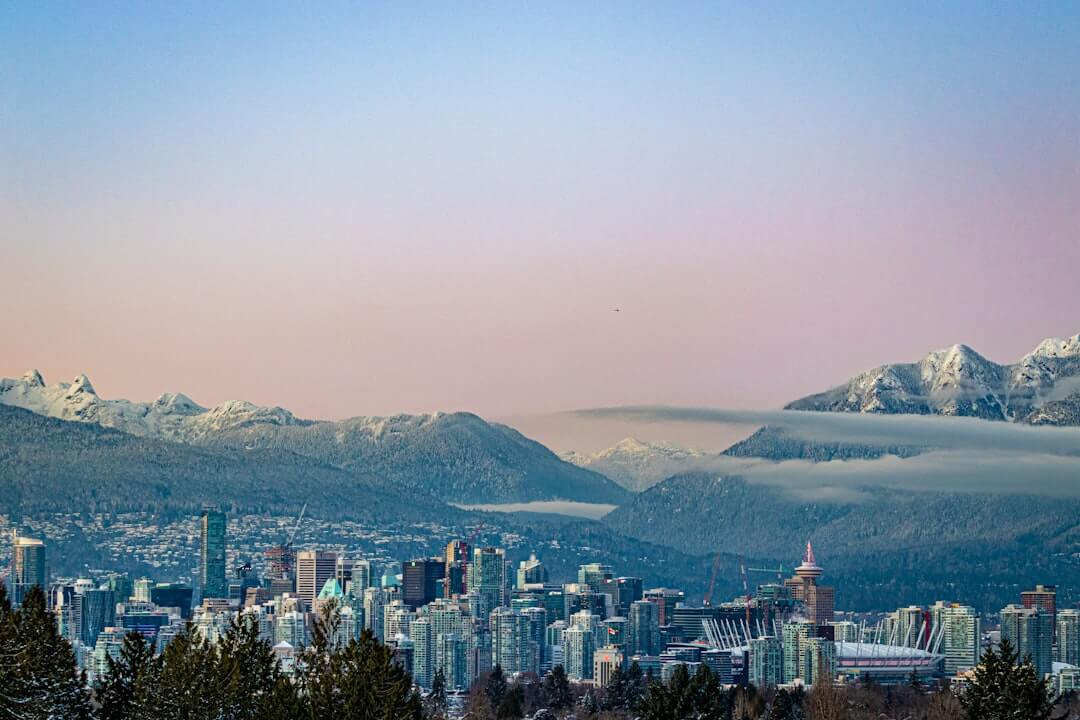
Vancouver is a small city by the numbers — about 700,000 people in the city proper — but the geography around it does most of the talking. The downtown peninsula sits between Burrard Inlet to the north, English Bay to the west, and False Creek to the south, with the North Shore mountains rising out of the water within walking sight. Everything important to a visitor is within a couple of kilometers of the same neighborhood. The trip works best when it leans into what Vancouver actually is: a compact city built around mountains, water, and the outdoors — not a bigger one trying to behave like Toronto or Montréal.
Vancouver is compact, and the geography is the reason
The first thing to internalize: downtown Vancouver is small enough to walk across in 30 minutes. Stanley Park sits at one end, the Granville Bridge at the other, and most of the visitor neighborhoods sit on the same peninsula. That’s the inside of the trip.
What’s outside the downtown is also close:
- North Vancouver and West Vancouver — across the Burrard Inlet, reachable by SeaBus or bridge. Grouse Mountain, Capilano Suspension Bridge, the Sea-to-Sky Highway.
- Kitsilano — across False Creek by aquabus or a 20-minute walk over the bridge. The beach neighborhood.
- Granville Island — a small pedestrian island under the Granville Bridge, reachable by aquabus or short walk. Food market, breweries, theatres.
- Richmond and the airport — south, connected by SkyTrain’s Canada Line. Asian food destination on Alexandra Road.
The version of the trip that works picks downtown as the base and treats the rest as half-day or full-day excursions from there.
Picking a base: five areas, five different versions of the trip
Most travelers stay downtown — and for once, that’s actually the right call. The differences are about which corner of downtown.
Downtown / Robson Street — The default first-time base. Walking distance to Stanley Park, Robson Street shopping, the convention centre, and Vancouver Art Gallery. SkyTrain stations at Burrard, Granville, and Vancouver City Centre. Tradeoff: dense and tourist-heavy, with chain restaurants outnumbering independent ones in some blocks. Strong base for a short trip.
Coal Harbour — A quieter waterfront neighborhood at the north edge of downtown, with the seawall on the doorstep and Stanley Park a 10-minute walk. Hotels skew higher-end. Strong choice for travelers who want easy water access and a calmer evening rhythm.
Yaletown — Former industrial neighborhood turned upscale dining and loft district. Brick warehouses converted to restaurants and apartments, walking distance to False Creek and the seawall. Canada Line SkyTrain at Yaletown-Roundhouse station. Strong base for a food-focused trip or a second visit.
West End — Residential, leafy, between downtown and Stanley Park. The most local-feeling base in the city. Walking distance to English Bay, Davie Street’s pride flag corridor, and Stanley Park. Tradeoff: fewer hotel options than downtown proper. Strong for travelers who want a quieter neighborhood feel.
Gastown — The city’s oldest neighborhood, with cobblestone streets, historic buildings, and a busier nightlife scene. Boutiques, restaurants, the iconic Steam Clock. Tradeoff: some surrounding blocks (the Downtown Eastside, just to the east) have significant visible homelessness and drug-use issues that catch some visitors off guard. Choose Gastown if the history and walkability matter and you’re prepared for the contrast on adjacent streets.
Kitsilano is worth knowing about as a base option for longer trips — beachy, residential, slower — but it’s further from the convention centre, the cruise terminal, and the downtown sights. Usually better as a second-half-of-the-trip base than a first arrival.
Getting around: SkyTrain, SeaBus, aquabus, walking
Vancouver’s transit is unusually good for a North American city of its size, partly because the downtown is so compact that you can walk most of it.
SkyTrain. Three lines (Expo, Millennium, Canada) connecting downtown to the airport (YVR), Richmond, Burnaby, Surrey, and northeast suburbs. Trains are fully automated — no driver, no conductor. Fast, frequent, and quiet. Fare runs $3.20–$6.55 with a Compass card or contactless tap, depending on zones. The Canada Line ride from YVR to downtown is 25 minutes and is the easiest airport-to-downtown experience in any Canadian city.
SeaBus. A passenger ferry from downtown (Waterfront Station) to North Vancouver (Lonsdale Quay). 12-minute crossing, runs every 15–30 minutes. The right way to reach Lonsdale Quay Market or to start the trip up to Grouse Mountain.
Aquabus / False Creek Ferries. Small boats that hop across False Creek between downtown, Granville Island, and Olympic Village. Cheap and useful — saves a long walk over the bridge.
Bus. Extensive network. Useful for Kitsilano, Commercial Drive, and the further neighborhoods not covered by SkyTrain.
Walking and biking. The downtown is one of the most walkable in North America. The seawall — a 28 km paved path circling the downtown peninsula, including all of Stanley Park’s perimeter — is the best urban walk or bike route in Canada.
Driving. Optional. Useful for the North Shore mountains and day trips to Whistler or the Okanagan, but most of downtown isn’t a driving experience.
A reasonable mix for a first trip: Compass card for SkyTrain and SeaBus, walking everywhere downtown, bike rental for one day on the seawall, Uber or Lyft for late nights.
Summer in Vancouver: mild, dry, and the only reliable season
The famous Vancouver rain is real, but summer is the exception. June through August averages 18–24°C with relatively low humidity and surprisingly little rain — the dry season runs roughly from June through September. Visitors who expect a rainy Vancouver in July are usually pleasantly surprised.
What this means for planning:
- Most days are walkable — the temperature, humidity, and rain risk all cooperate
- June can still have cool mornings and overcast spells; July and August are reliably warm
- Long evenings — Vancouver sits at a high latitude, so sunset is around 9 p.m. in late June. Patios run late.
- Beach culture is real but the water is cold — Pacific Ocean temperatures don’t get much above 16°C even in August. Pack accordingly if Kits Beach is on the list.
The marine air keeps the city from getting truly hot. There’s no Miami-style late-afternoon storm pattern.
A loose four-to-five-day shape that works
This is the rhythm that consistently produces a good first Vancouver trip.
- Day 1 (arrival): SkyTrain from YVR to downtown, settle in. Walk to the seawall, dinner in Yaletown or the West End.
- Day 2 (Stanley Park + downtown): Bike or walk the park’s seawall loop, dinner in Gastown.
- Day 3 (Granville Island + Kitsilano): Aquabus to Granville Island in the morning, food market, walk along False Creek to Kits Beach in the afternoon.
- Day 4 (North Shore): SeaBus to Lonsdale Quay, then Grouse Mountain or Capilano Suspension Bridge for the day.
- Day 5 (longer day out): Whistler day trip (2 hours by Sea-to-Sky Highway), Victoria via ferry, or a slower second look at a neighborhood.
For longer trips, the easy add-ons are Vancouver Island (Victoria as a short visit, Tofino as a 2–3 day west coast escape), Whistler (mountain biking, hiking, gondolas in summer), or the Okanagan Valley for wine country.
What disappoints first-time visitors
The honest list:
- The Downtown Eastside. A few blocks east of Gastown, Vancouver has one of the most visible drug-use and homelessness crises in North America. It’s a real part of the city, and it’s distressing to walk through. Worth knowing in advance.
- Restaurant prices. Vancouver is one of Canada’s most expensive food cities. Dinner-with-drinks for two routinely runs $150–250 CAD at a mid-range place.
- The water is cold. “Beach city” doesn’t mean swimming-warm ocean.
- Mountain weather can change fast. A clear morning at Grouse can turn to fog by afternoon. Layers matter.
- Cruise season crowds. Vancouver is a major Alaska-cruise port; downtown gets dense on the days big ships are in.
None of this makes Vancouver a bad trip. It makes it a city that rewards picking a downtown base, using the seawall as a daily route, and letting the geography do the planning. Vancouver isn’t a long-itinerary city — it’s a short, dense, well-located one.
Visiting during the 2026 FIFA World Cup? BC Place hosts seven matches between June 13 and July 7, including two Canada home games, a Round of 32, and a Round of 16. The stadium is downtown — but the official Fan Festival is across town at the PNE in Hastings Park, and match-day SkyTrain routing changes from the usual. The logistics sit in a separate piece: Seven Matches Under a Roof: BC Place at the 2026 World Cup.